
For Policymakers
Palliative care is specialized medical care focused on relief of the symptoms and stress of serious illness. The goal is to improve quality of life for both patient and family.
Palliative care is provided by a specially-trained team that includes physicians, nurses and other specialists who work together with a patient’s other doctors to provide an extra layer of support. Palliative care is appropriate at any age and any stage in a serious illness, and it can be provided along with curative treatment.
It is based on need, not prognosis.
Diffusion of Healthcare Innovation
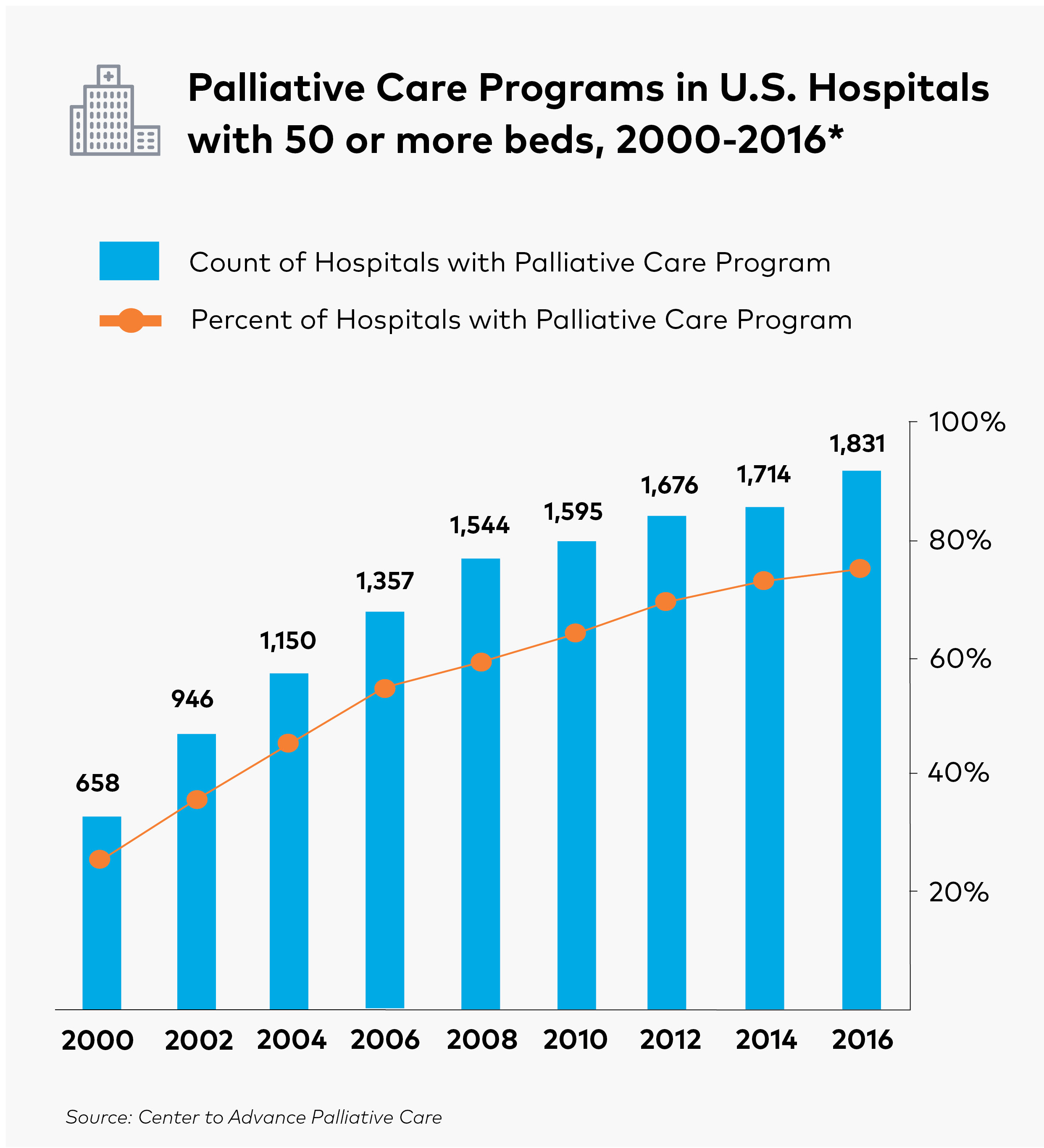
Over the last decade palliative care has been one of the fastest growing trends in health care. In fact, palliative care prevalence in U.S. hospitals has shown a steady increase since 2000. Today, 72 percent of U.S. hospitals with fifty or more beds report a palliative care team. This is up from 67 percent in 2015, 53 percent in 2008, and 7 percent in 2001.
This growth has occurred primarily in response to the increasing number of Americans living with serious illnesses, and to the caregiving realities faced by their families. But today’s healthcare delivery system is still mismatched to the needs of seriously ill patients because it is not designed to meet their needs. Our fragmented health care system makes it difficult to effectively treat seriously ill patients—just when their numbers and needs are growing exponentially.
Palliative care responds to this because it is focused on the episodic, long-term, and costly nature of serious, multifaceted illness. It ensures that symptoms and side effects are managed, treatment goals are matched to personal goals, and communication is maintained in what is often a long, complex course of serious illness.
Research Shows People Want Palliative Care
Palliative care is expected to increase as the public becomes more aware of its benefits. Recent public opinion research by the national polling firm Public Opinion Strategies reveals that even for those who are uninformed about palliative care, once informed 90% said that they would be likely to consider palliative care for a loved one if they had a serious illness. Additionally, 94% stated it is important that palliative care services be made available at all hospitals for patients with a serious illness and their families. And 90% agreed that it should be covered by health insurance.
Improved Quality Leads to Cost Reduction
Today, millions of Americans are living with serious illness, and this number is expected to grow exponentially over the next 25 years. About 20% of all Medicare beneficiaries have 5 or more chronic conditions, and two-thirds of Medicare spending goes to cover their care. This patient population is also the most likely to benefit from palliative care. Recent studies indicate that by closely matching treatments with patients’ goals, and improving their quality of life and quality of care, palliative care can also provide substantial cost reduction.
Policy Changes Would Help
Policy initiatives that address workforce needs, research and payment models linked to quality measures could rapidly bring palliative care to scale in the United States. The implementation of necessary policies will enable the US to meet the needs of our highest-need, highest-cost patient populations. Learn more by reading America’s Care of Serious Illness: A State-by-State Report Card on Access to Palliaitive Care in Our Nation’s Hospitals and the policy section of capc.org.
 EN
EN  ES
ES